PERFORMANCE GUIDELINES: APPENDICES
A6 Chipped Clay Bricks
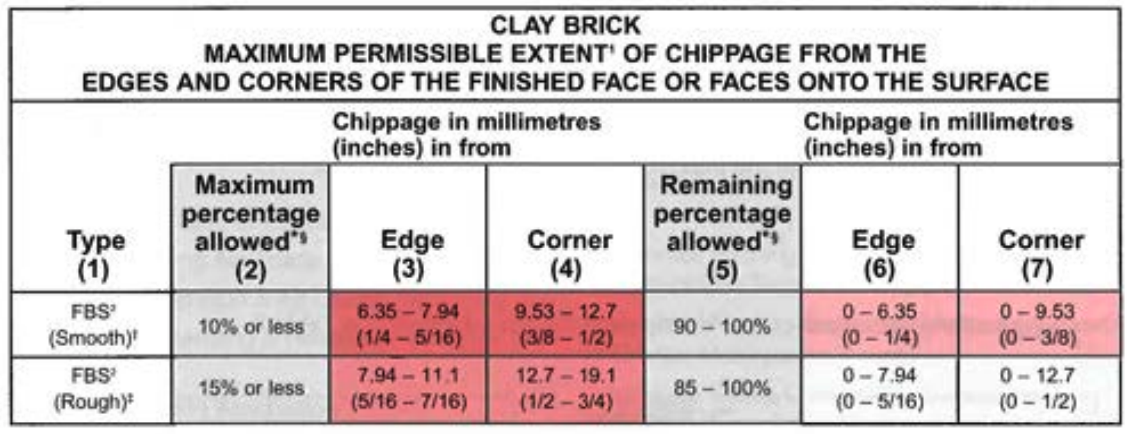
Table 3 is from the Canadian Standards Association, CSA A82.1-M87: Burned Clay Bricks.
* Percentage of exposed brick allowed in the wall with chips measured the listed dimensions in from an edge or corner:
- Smooth texture is the unbroken natural die finish.
- Rough texture is the finish produced when the face is sanded, combed, scratched or scarified, or the die skin on the face is entirely broken by mechanical means, such as wire cutting or wire brushing.
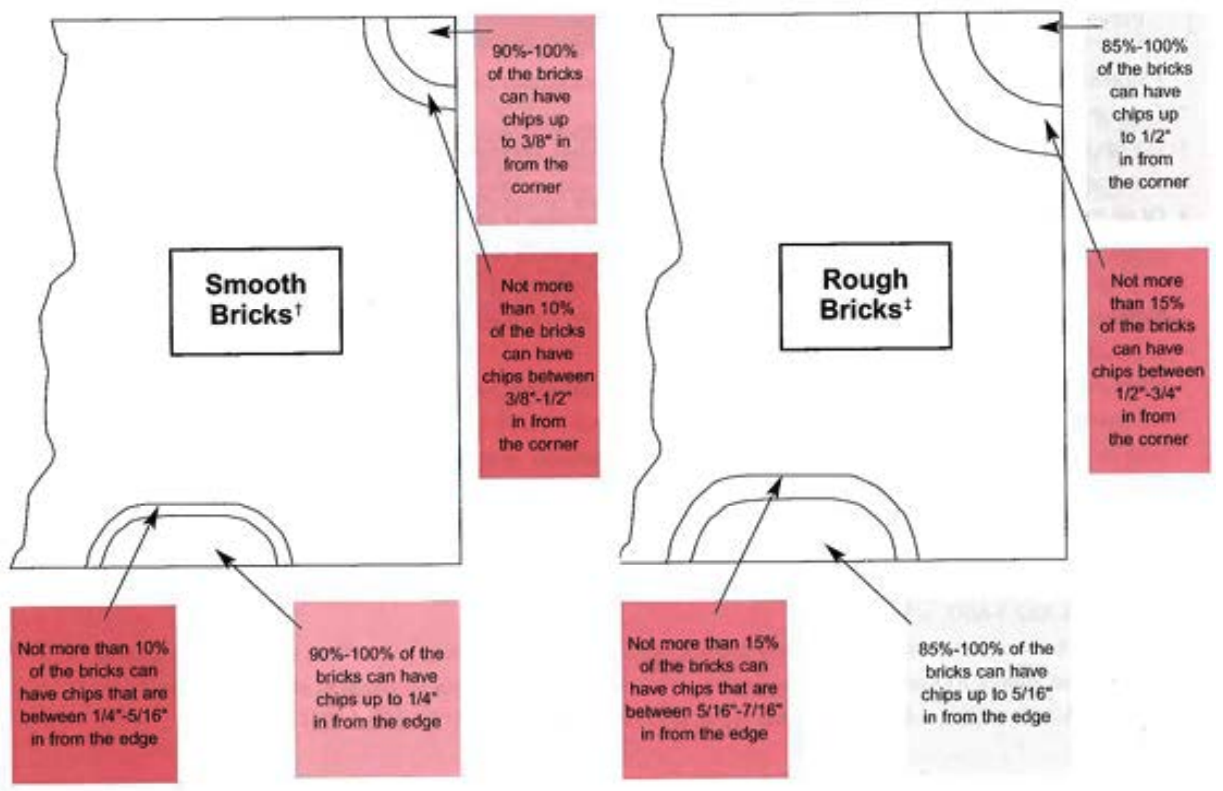
Of all the units that will be exposed in place, a small percentage of the units may have chips that range in size greater than that allowed for the majority of the units. This special allowed percentage, as shown in the second column from the left, ranges up to 10% for FBS (smooth), and up to 15% for FBS (rough). The rest of the units that will be exposed in place, as shown in the fifth column from the left, just conform to the maximum allowed chippage shown in the sixth and seventh columns from the left.
Example: The units to be placed into the wall should be inspected prior to being placed. The FBS (smooth) units will then conform to the requirements of this table if not more that 10% of the units have edge chips greater than 6.35 mm (1/4") but less than 7.94mm (5/16"), and the remainder of the units, in this example 90% (100% - 10%), do not have edge chips greater than 6.35mm (1/4") in from the edge or 9.53mm (3/8") in from the corner.
Notes
The aggregate length of chips shall not exceed 10% of the perimeter of the face of the brick (CAN/CSA-A82.1-M87, s.7.3).
Type FBS brick is the most common type of brick used in residential construction. They are used in exposed exterior and interior masonry walls where wider colour ranges and greater variation in sizes are allowed (CAN/CSA-A82.1-M87, s.4.1.2). For other types of bricks, refer to CAN/CSAA82.1-M87.
With the permission of Canadian Standards Association, material is reproduced from CSA Standard CAN/CSA-A82.1-M87, which is copyrighted by Canadian Standards Association, 178 Rexdale Blvd., Toronto, Ontario, M9W 1R3, http://www.csa.ca. While use of this material has been authorized, CSA shall not be responsible for the manner in which the information is presented, nor for any interpretations thereof.
Using a representative sample to determine the percentages of affected bricks A representative sample may be used to determine the percentage of bricks (Columns 2 and 5 in Table 3) that have chips of specified sizes.
The representative sample (versus an isolated section of the wall with the chipped brick problem) shall be 1m x 1m (3’ – 3” x 3’ – 3”) in size with the centre of the sample located 1.5m (5') above the foundation in the middle of the wall. If the sample lands on an opening (window, door, etc.), it shall be moved horizontally in the direction of the most brick in the sample so a full square metre of brick is sampled.
Individual bricks must still meet the maximum chip dimensions noted in Table 3.